

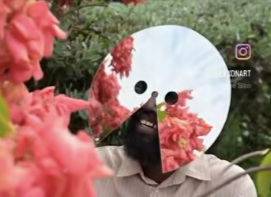
Editor’s Note: Let’s go behind the scenes with internationally acclaimed Jamaican poet and photographer, Adrian McDonald (@lexonart), who offers us a glimpse into the creative process behind his latest work.
The short film explores the concept of awareness and is guided by a deceptively simple question: “How do you visually represent awareness?”
See below to read the artist’s statement and experience the work in full.
Artist Statement: How does one visually represent awareness?
I have always been fascinated by the idea that beneath our different identities and experiences, we are all the same awareness expressing itself through different forms, so the idea for this project came from a question that had stayed with me for a long time: how do you visually represent awareness?
While browsing Instagram, I came across the work of a UK artist named Freddie, who creates wearable mirrored sculptures. Watching his work, I realised I had found the perfect tool for the idea I had.
The mirror became the perfect metaphor for awareness itself: something that simply reflects, observes, and remains unchanged by what it encounters.
The film is, at its core, a symbolic interpretation of the fall of man. Rather than presenting this idea literally, I wanted it to exist as an underlying current, allowing viewers to discover it for themselves rather than having it explained to them.
The story begins in nature, where the mirrored figure simply exists in a state of presence and observation. There is an innocence to these opening moments, where awareness is fully immersed in the beauty of the natural world. As the film progresses, the figure begins to journey outward. The growing presence of lush greenery symbolises exploration and discovery.
A turning point arrives when the figure is seen riding a bicycle, one of the first distinctly man-made elements introduced into the film. As he looks down at his hands, the narrative shifts from pure awareness toward self-consciousness. It represents the moment where attention turns inward, and identity begins to emerge. Later, the figure sits comfortably while surrounded by floating plastic.
This plastic serves as a metaphor for the veil of forgetfulness that humanity lives beneath. It is transparent enough that reality remains visible, yet it subtly separates us from our true nature, causing us to forget our origins and our connection to the world around us.
Toward the end of the film, the figure is once again surrounded by nature, sitting high within a tree. Although he has physically returned to the natural world, something has changed. The childlike wonder that existed at the beginning has faded.
The film concludes where it began, with flowers. In the opening, they evoke curiosity and presence. In the final scene, the figure stands before the same flowers with a slumped posture, looking at them without any sense of wonder.
The flowers have not changed, but he has. Ultimately, the work reflects on how modern life often distances us from simple awareness. We move constantly from one task to the next, rarely noticing the quiet beauty that has always been present around us.
The film is an invitation to rediscover the art of noticing, and to reconnect with the sense of presence we all possessed before becoming consumed by distraction and self-consciousness.
 Tami Tsansai