

Editor’s Note:
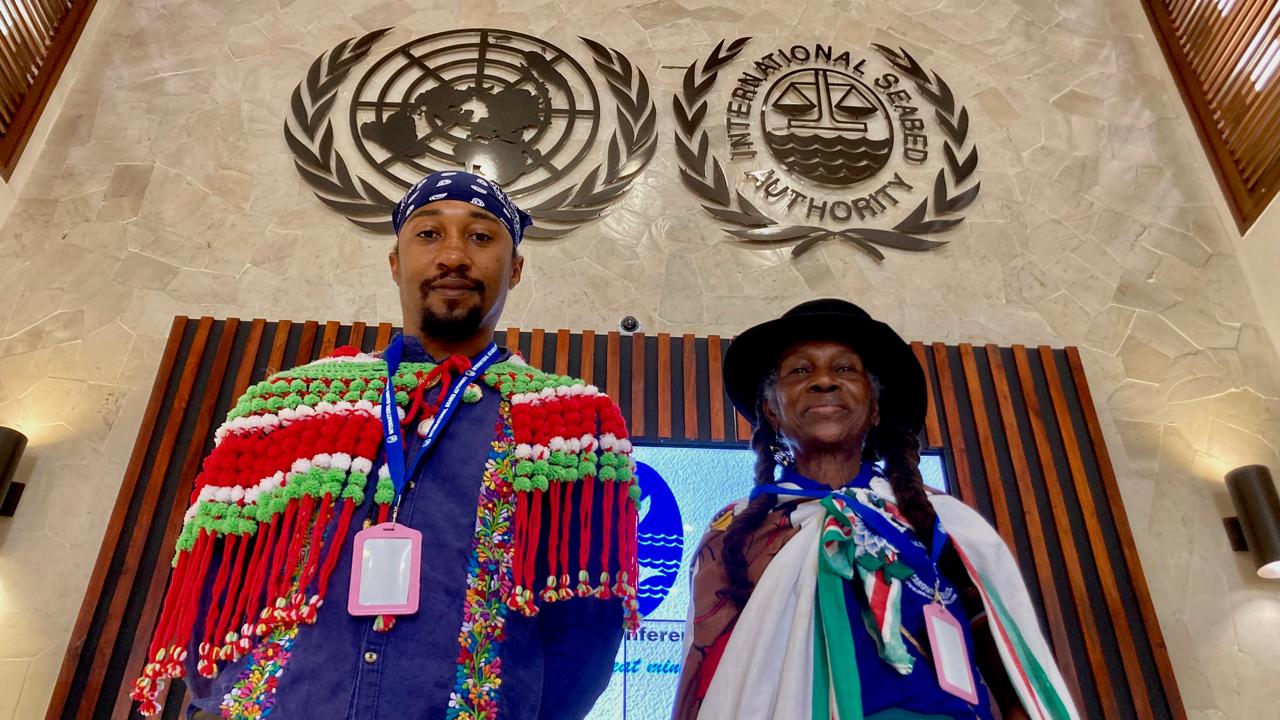
Recently, members of Jamaica’s Indigenous communities were granted an opportunity at the invitation of TBA21 (Thyssen-Bornemisza Art Contemporary) to share an address and participate in a week of activities at the 31st International Seabed Authority Assembly in Kingston, Jamaica.
As the official media partner of the Yamaye Guani Taino Peoples, we bring you an official statement shared by Kasike/Behike Kalaan Nibonrix Kaiman, Chief of the Yamaye Guani Taino Peoples, who, incidentally celebrates birthday today on International Day of the World’s Indigenous Peoples, and Gaa Mang/Gaama Gloria “Mama G” Simms, representing the Maroon Indigenous Women’s Council. Watch this space for a more detailed account of their participation coming soon.
Language carries memory, too. This transcript features words and phrases from Wahiyani or Island Arawakan spoken by Taino Peoples and their relatives.
(See full transcript below)
Yamaye Guani Council and the Maroon Indigenous Women’s Circle Statement: International Seabed Authority (ISA) Assembly
Mabrika Dayukunu, Ikone dahiya warico orokotino, aketenu, Ceminu warico yaka.
(Greetings, my relatives. Today we call upon the grandfathers, grandmothers, and ancestral spirits to join us.)
Hahom (Thank you), Mr. President, distinguished delegates, and observers. Special thanks to TBA21 for facilitating this opportunity to share our statement.
As this is the first time this delegation has spoken in the Assembly, we respectfully greet the Secretary-General, congratulate you, Mr. President, on your election, and thank the Government and people of Jamaica for hosting this Assembly.
We acknowledge the Yamaye Council of Indigenous Leaders (YCOIL), our Maroon relatives, COIP, the Council of Indigenous Traditional Healers of the Americas, and the Peace and Dignity Journeys across Abya Yala.
I speak as Kasike Kalaan Nibonrix Kaiman, Chief of the Yamaye Guani Taíno Peoples—the First Peoples of Jamaica and ancestral custodians of the Caribbean. A people thought to be lost to history, but we are still here.
With me is Gaama Mama G, Paramount Queen of the Maroons of the Diaspora—Africans brought through the Transatlantic Slave Trade who escaped the plantocracy, settled free villages with our Taíno relatives, and negotiated treaties with the colonizers for autonomy.
We come as caretakers of an ocean that sustains all life. The Atlantic seabed is a living repository of historical memory—the sacred resting place of millions lost to the Transatlantic Slave Trade. Culture is a living experience that must refine the decisions made here.
II. Lived Heritage & Precaution
Our elders teach us that the earth does not belong to us—we belong to the earth. We are children of Atabey, the Taíno Mother of Waters, from the coasts to the valleys; and of Mama Wata, for our Jamaican Maroons, from the valleys to the mountains. As a collective, we hold sacred everything from the mountain rivers to the ocean deeps.
In Jamaica, our communities are fenced off from beaches where we go to give offerings. Deep-sea mining risks repeating this tragedy globally.
We stand in solidarity with leaders who remind us that the ocean is a living system to be guarded. Together with the petition by the Asia Indigenous Peoples Network on Extractive Industries and Energy (AIPNEE) and the Deep Sea Conservation Coalition, we stand in support of a moratorium. States must also uphold UNCLOS Articles 137 and 139 to block illegal operations.
As we do not intend to intervene again, we also register our support for Vanuatu’s scientific agenda, mandate the overdue Article 154 Governance Review, and reject corporate capture.
III. Policy Advocacy & Call to Action
Because our relationship with the ocean is sacred and lived, the decisions of this Authority must reflect the living reality of Indigenous Peoples. We advocate for the inclusion of Indigenous participation and the essential role of culture in the future of seabed governance—governing an ocean that is the common heritage of all: plant-kind, stone-kind, animal-kind, and humankind.
Centuries ago, Yamaye Maroon and Taíno ancestors negotiated in Jamaica’s mountains to defend our culture. Today, we carry that legacy onto this floor. We advocate for full UNDRIP implementation within the ISA so that informal dialogue becomes a formal mechanism, establishing our independent Permanent Observer status.
We have maintained a deep relationship with the spirit of the sea for centuries; she has educated, fed, and healed our people for generations. We are tasked with sharing this wisdom with the world to play our part in advancing the welfare of the human race. True progress means making decisions today that safeguard living seas for generations to come.
Though we did not have the opportunity to formally bless this gathering at its opening, we take this opportunity now to welcome you all to our island home.
May you take this opportunity to nourish your spirits—for we are all children of the land and sea, regardless of where we reside or the titles we carry. Our lineages connect to the common root of all life.
Mabrika Yamayeka — Welcome to Jamaica.
Yayabo Huma (May the Great Spirit be with you all). Janjan catu (And so it is).
Hahom (Thank you), Mr. President.
Delivered by: Kasike Kalaan & Gaama Mama G
###
 Tami Tsansai