


The controversy over the national football jersey exposes a larger tension between Jamaica’s sovereign symbols and the global cultural power of reggae and Rastafari.
—Coleen Douglas
Editor’s Note
Debate continues around the proposed design of Jamaica’s national football kit and the use of reggae and Rastafari symbolism in national branding. In this column, Writes and Kulcha contributor Coleen Douglas examines the broader cultural and political questions raised by the discussion.
“Hardships there are, but the land is green and the sun shineth.”
This was one of the lines we recited in primary school in the 1980s. Later, we were taught that the black in the Jamaican flag represented the people. I remember embracing that shift and feeling seen as a little Black girl in our national colours.
Yet even as the flag affirmed Blackness symbolically, Jamaican language continued to associate “black” with the negative: blacklist, black sheep, black-heart man, black market. The older meaning never quite disappeared. “Black” still functioned as shorthand for lack, hardship, or something to overcome.

The “Road to France” in 1998 was my first lived experience of collective national pride. As the Reggae Boyz advanced to the World Cup, their uniforms carried the colours of the Jamaican flag onto the global stage. The gold and green stood bold and unmistakable, while black appeared mostly as an accent.
Fast forward to 2026. We are now presented with a football kit in which the colours of the Jamaican flag appear alongside colours associated with Rastafari, framed as a celebration of reggae.
Reggae and Rastafari are historically intertwined. The global appeal of reggae can hardly be separated from the political and cultural framework of the Rastafari movement.
Jamaica, however, has always maintained a complicated relationship with Rastafari. The nation embraces its symbols when they are marketable, when red, gold and green are visually compelling, when dreadlocks are fashionable and rebellion can be packaged as culture. Yet many adherents of the faith still navigate discrimination in schools, workplaces and public institutions.
It is within this unresolved tension that the jersey debate sits.
The issue is not simply which colours appear on a shirt, but what their prioritisation signifies.
We grew up proud of our flag. Its composition was deliberate, its symbolism memorised and internalised. It is therefore unsurprising that there is public debate about a proposal for our national football team to wear black, green and gold in a configuration that appears to foreground Rastafari or Ethiopian aesthetics over the established order of the Jamaican flag.
This is not merely a stylistic adjustment. It is a question of nation branding, cultural capital and symbolic power.
Read more: THE PULSE: Brand Reggae or Brand Jamaica?The Flag as a Sovereign Brand

The Jamaican flag, adopted at Independence in 1962, functions as what nation-branding scholar Simon Anholt describes as a condensed narrative of state identity. National symbols operate as reputational shortcuts, signalling sovereignty and legitimacy in global arenas.
When a national team enters an international stadium, its jersey performs before the anthem is even heard. The colours worn by athletes representing a country are never purely decorative.
I understand the complexity of the debate. Our footballers carry the name “reggae,” and reggae carries Rastafari symbolism. Yet the question remains clear: is red, gold and green an expression of Jamaican culture, or is black, gold and green the sovereign emblem of Jamaica?
Rastafari Colours as Global Cultural Capital
The Rastafari movement draws its colour symbolism from Ethiopia, particularly the imperial standard associated with Haile Selassie I and the Lion of Judah. Within Rastafari traditions the sequencing varies. The Nyabinghi order often uses green, gold and red, while the Bobo Ashanti tradition prominently uses red, gold and green.
For Rastafari adherents these colours carry theological and historical meaning. Red represents the blood shed in struggle, green the land and African redemption, and gold divine promise and prosperity.

Music reinforced this symbolism globally. Rita Marley’s lyric “ites, green and gold, Rasta at the controls” and songs such as Kabaka Pyramid’s “Red Gold and Green Anthem” circulate these colours as visual shorthand for reggae culture.
Through reggae — amplified globally by Bob Marley — these colours achieved extraordinary international recognition. In many markets they signal “Jamaica” more immediately than the diagonal gold cross of the national flag.
Joseph Nye’s concept of soft power is useful here. Soft power describes influence secured through attraction rather than coercion. Despite Jamaica’s remarkable success in track and field, reggae remains arguably the country’s most powerful soft power asset.
Reggae has generated what sociologist Pierre Bourdieu described as symbolic capital — cultural authority and reputation that can be converted into economic value and influence. The question is not whether this capital exists, but who governs its deployment. Is it the Marley family through the Bob Marley Foundation, the Jamaica Football Federation, the state, or the wider culture that produced it?
The Commodification of Culture

Cultural theorist Stuart Hall reminds us that representation is always a struggle over meaning.
When Rastafari colours enter sportswear branding, their symbolism does not remain fixed. What was once sacred or political can become aesthetic and marketable.
Arjun Appadurai’s theory of global cultural flows helps explain this transformation. As symbols circulate through global markets and media systems, they detach from their original communities and acquire new value within consumer economies. When symbols move from sacred context to marketplace, meaning — and control — shifts.
Brand Reggae or Brand Jamaica
The partnership between Adidas and the Bob Marley Foundation operates within formal intellectual property law. The Marley name and associated branding are legally protected and licensable.
Yet Rastafari itself is not a corporation. It is a faith and a community. Its symbols — red, gold and green, the Lion of Judah, and the aesthetic that shaped reggae — did not originate as commercial assets. They emerged from a collective spiritual and political movement.
Bob Marley himself repeatedly emphasised that he was not an isolated icon but part of a wider Rastafari community. His message pointed beyond the individual artist toward Africa, faith and liberation.
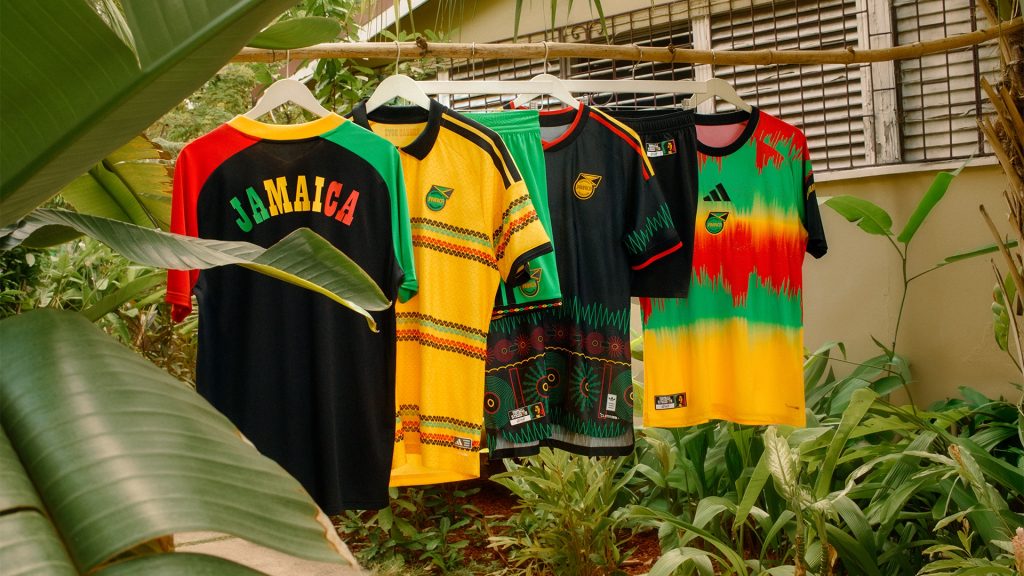
If corporate agreements now allow the global sale of Rastafari-inflected national imagery because of Marley’s brand power, does that extend to the wider Rastafari community whose theology and symbolism underpin that brand?
Legal ownership may be settled. Moral ownership is more complex.
Rastafari, once criminalised in Jamaica, now enjoys global celebration. Its imagery has moved from marginalisation to monetisation.
If a national jersey foregrounds Rastafari aesthetics without engaging the wider community whose beliefs shaped that symbolism, the issue is not merely design.
It becomes a question of whether cultural heritage is being licensed without fully honouring its source.
The Jersey Debate
The success of the Marley brand reveals a deeper tension between Brand Jamaica and Brand Reggae.
Reggae communicates authenticity, resistance and African consciousness. It has generated reputational equity that official nation-branding campaigns could never have manufactured. In the absence of a sustained state branding strategy, Jamaica’s global image has been shaped as much by musicians as by ministries.
A serious nation defines itself deliberately — honouring its sovereignty while integrating the cultural forces that built its reputation. The country celebrates reggae as a national treasure. We dedicate an entire month to its honour. We proudly adopted the names Reggae Boyz and Reggae Girlz.
Yet we now find ourselves debating whether reggae symbolism should appear visually on the national football kit itself.

The jersey debate exposes a contradiction. This debate is not merely about the jersey, it is about coherence.
We cannot deny the Marley family’s tangible investment in sport and community, nor the pivotal role Cedella Marley played in reviving the Reggae Girlz. That commitment deserves respect.
The Jamaican flag is sovereign and must never be displaced casually. Rastafari colours, though globally influential through reggae, are not uniquely Jamaican in origin. Yet reggae and Rastafari have undeniably shaped Jamaica’s global identity in ways few official campaigns ever have.
The issue, then, is not erasure but alignment.
If we foreground Rastafari aesthetics, we must articulate why. If we insist on centering only the national palette, we must also interrogate branding choices such as “Reggae Boyz” and “Reggae Girlz.”
Consistency matters. If Jamaica is to balance Brand Reggae and Brand Jamaica, it must do so consciously — respecting the sovereignty of its national symbols while acknowledging the cultural forces that built its global reputation.

Coleen Douglas is a Lecturer in Integrated Marketing Communication at the University of Technology (UTECH), Kingston, Jamaica. She has over twenty-five years in media and event production and is actively involved in the Jamaica music industry and Rastafari community.
 Tami Tsansai
  WK Admin