

Editor’s Note
As conversations around wellness, food sovereignty, and community economies continue to grow in Jamaica, we’re sharing the following press release from the Wellness Caribbean Symposium 2026, which brought practitioners, farmers, and policy voices into dialogue.
Wellness Symposium 2026 convened practitioners, cultural leaders, farmers, policy influencers, and wellness entrepreneurs in Kingston, Jamaica, for an exploration of healing as practice, economy, and way of life. The exchanges were anchored by insightful dialogue, a vibrant wellness marketplace, and a consciously curated healthy kitchen with Kamila’s Kitchen, Veggie Meals on Wheels and Living Foods and Juices.
Featured Speakers
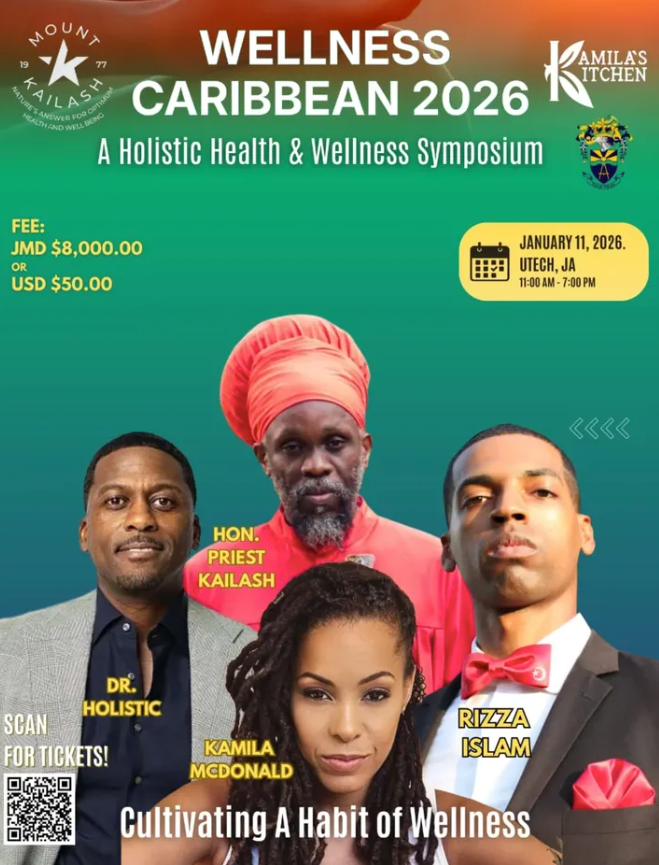
The event featured three keynote addresses delivered by holistic medical practitioners, Honourable Priest Kailash K. Leonce of Mount Kailash rejuvenation Centre – St Lucia, Dr Bobby “Holistic” Price and activist Rizza Islam. Balancing off the diet was a presentation on Dental Health with Dr Denise Moore-Ebhomenin, a Gut Health Lecture demonstration by Kamila McDonald, a movement medicine session by Integrative Yoga Practitioner Trishan Haughton and fitness expert Nyham Edwin, and two panels moderated by Dr. Kadamawe Knife of the Mona School of Business and Dr. David Picking of the UWI.
Dr. Holistic underscored that sustainable health outcomes require consistency, discipline, and education and not to be seen as a trend but a systems issue rooted in daily habits, environmental exposure, and emotional regulation. He rooted his presentation in his Caribbean roots, reinforcing the importance of preventative care through informed self-advocacy, and integrating traditional knowledge with contemporary health science.
Rizza Islam challenged participants to interrogate the political economy of food, health, and media narratives. He highlighted how misinformation, dietary colonialism, and cultural disconnection undermine community wellbeing, urging those present and online to reclaim ancestral intelligence and approach wellness as an act of self-determination and conscious choice.
The Honourable Priest Kailash brought a grounding spiritual and ethical lens to the conversation, reminding attendees that healing must be aligned with values, service, and responsibility. He framed wellness as right relationship with self, community, and nature. His points were earlier underscored by Dr. Ben Yisrael who reiterated the striking contrasts between traditional and western medicine and the ethical dilemma of the health industry on the panel – Healing the Whole from Plant Based Medicine to culturally rooted healthcare. The panel, led by Dr. David Picking also featured Kandake Makonnen, Tehuti Maat and Nicola Shirley-Phillips. The panelists were attached to Source Farm in St. Thomas and Ujima Market and played a vital role in grounding the symposium in practice, sharing insights on regenerative agriculture, soil health, and the realities of producing clean food within a changing climate. Their contributions reinforced the vision of founder Hon. Priest Kailash that wellness begins at the source and grounded the symposium in local knowledges and the people of Jamaica.
Wellness, Culture, and the Tourism Economy
A central moment of the symposium was a moderated panel led by Dr. Kadamawe Knife of the Mona School of Business, which examined the intersections of wellness, culture, and economic development. Panelists included Carey Wallace, Executive Director of the Tourism Enhancement Fund, Tehuti Maat, Kerry Coote of Living Fruits and Juices, and Honourable Priest Kailash. Guided by Dr. Knife was a rigorous and culturally grounded discussion, challenging panelists to move beyond generic wellness branding of Jamaica toward authentic, locally rooted frameworks. Dr. Carey Wallace was challenged to consciously and formally acknowledge Rastafari as a foundational contributor to Jamaica’s wellness philosophy within the national tourism agenda, particularly given its global influence on plant-based living, ital food, spiritual practice, and holistic health.
The intervention was widely noted as a necessary and overdue call to align policy with lived cultural reality, reinforcing that Jamaica’s wellness capital cannot be fully articulated without recognising Rastafari knowledge systems and practitioners.
Marketplace and Healthy Kitchen Experience
The Wellness Marketplace functioned as a living extension of the symposium’s ideas, translating theory into taste, texture, and transaction. The Healthy Kitchen featuring Kamila’s Kitchen, Veggie Meals on Wheels, and Living Fruits and Juices offered nutrient-dense meals and beverages that modeled accessible, culturally relevant wellness. Together, these enterprises demonstrated that health-centred food systems can nourish bodies while sustaining local economies.
An Integrated Model for Future Wellness Programming
Wellness Symposium 2026 distinguished itself through its intentional integration of dialogue, practice, policy, and enterprise. By placing speakers, farmers, entrepreneurs, and institutional leaders in active conversation, the event modeled a collaborative ecosystem rather than a siloed conference experience.
As discussions continue beyond the symposium, the message remains clear that wellness is collective work that requires informed leadership, cultural truth-telling, rooted food systems, and economic strategies that honour the knowledge already present in the land and its people.
Wellness Caribbean Jamaica 2026 was coordinated by a three-member team of marketing communications expert and event coordinator Coleen Douglas, Kamila McDonald and the Honourable Priest Kailash K Leonce.
 Coleen Douglas
  Tami Tsansai